Device Location Retrieval
Retrieve a device’s network-derived location to power IoT operations, compliance checks, and location-based customer journeys.

Unlock reliable network-based location for real-world operations

Device Location Retrieval is a CAMARA Network API that lets you retrieve the geographic location of a target device as determined by the mobile network, useful when GPS is unavailable, unreliable, or too costly in terms of battery and app permissions.
Because the location comes from operator network data, it is more resistant to client-side spoofing than app-reported location signal, making it a strong building block for risk controls, compliance workflows, and IoT fleet visibility.
Device Location Retrieval returns a device’s network-derived location (area + timestamp).
This API can be used to:
- locate devices when GPS is degraded (indoor, dense urban, tunnels),
- improve fraud and compliance controls with operator-backed signals,
- monitor IoT assets at scale with a simple API call.
How it works
You request the location for a device identifier and optionally define how “fresh” the location must be using maxAge (e.g., request a recent location, or accept an older one). The API returns:
- lastLocationTime
- a location area representation (currently CIRCLE in Playground), including center coordinates and a radius in meters.
Benefits

Alternative solution to GPS
Provides accurate location data through methods other than traditional GPS, ensuring reliable positioning in various environments

Resistant against location spoofing
Ensures the integrity of location information by being resistant to attempts to manipulate or spoof the device’s location

Low energy consumption
Operates efficiently with minimal power usage, helping to extend device battery life

Works on GPS-unsupported devices
Functions effectively on devices that do not have GPS hardware, broadening its applicability
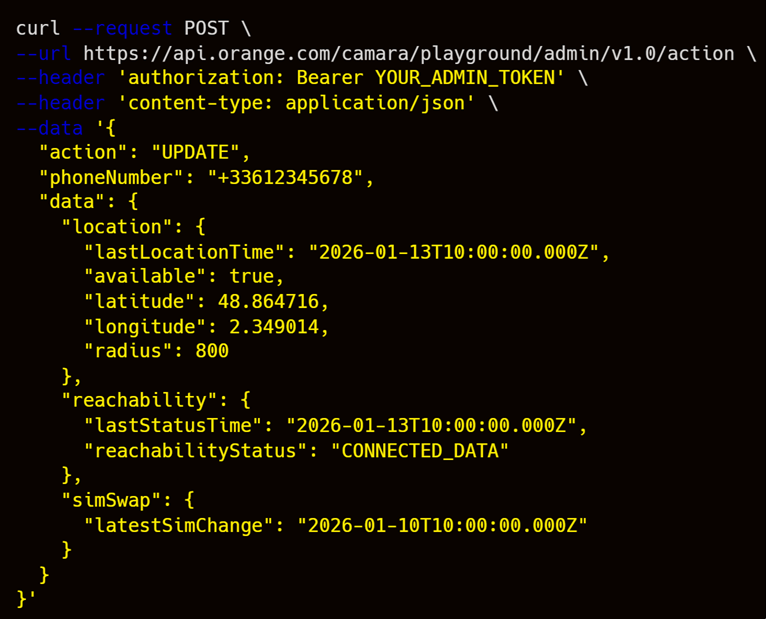
Test and explore our APIs with API Playground
Discover the API Playground: your interactive environment for testing and exploring Network APIs with ease! Prototype, validate, and experiment in real-time without impacting your live systems.
Get started today and bring your projects to life!
Case study
Proxymate: gamifying exploration with Location Retrieval
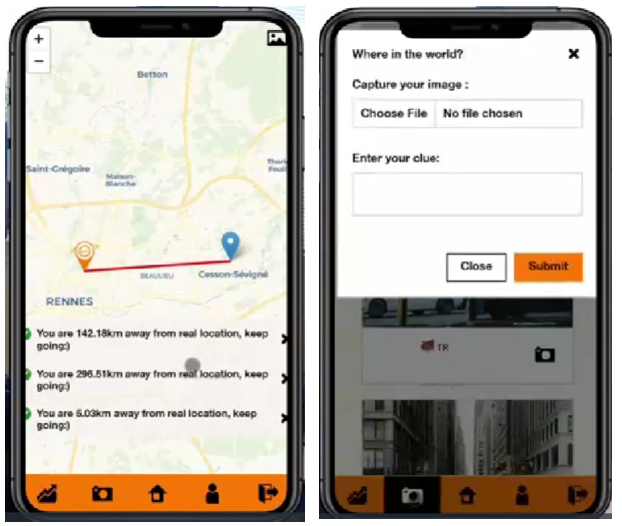
Proxymate is a photo-based game concept where each picture becomes a challenge: users post a photo and other players try to guess where it was taken. To make the experience work at scale, Proxymate relies on the CAMARA Location Retrieval API to associate a location signal to a photo and enable map-based gameplay and ranking.
Used APIs
Device Location Retrieval
Use cases
Fraud Prevention in Location-Dependent Transactions and Content Access
The system checks if the mobile device’s detected location matches the expected region when users perform actions like adding payees, changing security settings, or accessing premium content.
Service Personalization Based on Location
For services like streaming, retail, or travel, the system uses detected location data to customize offerings.
Location-Based Marketing and Advertising
When users enter specific areas such as shopping districts or tourist spots, brands can leverage their mobile network location to send personalized offers or advertisements.
Emergency Services
Accurate location information ensures that emergency services can quickly and effectively reach users in need, improving safety and response times.
Monitoring the real-time location of valuable assets
Continuous location tracking allows organizations to oversee the whereabouts of assets, improving security and operational efficiency.
IoT Asset Recovery (High-value equipment)
When an asset stops reporting over its usual telemetry channel, retrieve its last known network-derived location to accelerate recovery workflows and reduce downtime and replacement costs.
Cold-chain & Medical Logistics Exception Handling
For refrigerated containers or medical shipments, use location retrieval as an operator-backed signal to trigger exception handling (unexpected stop, route deviation investigation) when sensor data becomes inconsistent.
Connected Workforce Safety
In incident workflows, retrieve network-derived location for a worker device to support response coordination, especially where GPS is degraded (indoor facilities, underground, dense urban).
Frequently Asked Questions
If you omit it, you accept “any age” (the API still returns lastLocationTime).
If you set maxAge = 0, you request a fresh calculation; if it cannot be fulfilled, the API returns a dedicated error (Playground behavior documented).
Related APIs

Device Location Verification
Verify if a mobile device is within a geographical area.

Device Reachability Status
Query the connectivity status of a mobile device.