Quality on Demand
Better performance for critical applications when and where it’s needed.


What Quality on Demand provides

Quality on Demand (QoD) represents an evolution in traffic management: instead of assuming “best effort” connectivity, your service can request on-demand network treatment for the moments that are truly sensitive—transactions, real-time control, high-value sessions, and mission-critical operations.
With Quality on Demand, you can build new functionalities that require more precise control of connectivity quality, typically around performance (latency/throughput/jitter) and service continuity. The goal is simple: protect key user journeys from congestion-driven degradation, without forcing you to implement operator-specific integrations.
Quality on Demand is built around a straightforward idea: your application requests a temporary connectivity policy for a specific application flow. Your backend selects a quality of service profile (based on what the operator exposes), defines the target traffic flow between the device and your application server, and requests a Quality on Demand session for a limited duration.
How it works
Quality on Demand is built around a straightforward idea: your application requests a temporary connectivity policy for a specific application flow. Your backend selects a QoS profile (based on what the operator exposes), defines the target traffic flow between the device and your application server, and requests a Quality on Demand session for a limited duration.
- Discover the QoS profiles available (what performance levels can be requested) thanks to QoS Profile API available very soon
- Create a QoD session for a specific app flow during a critical step (payment, remote control, uplink, etc.).
- Monitor session lifecycle (status, end time), and stop/extend when needed.
- Use callbacks/notifications where available to keep your service state aligned with the network session.
Benefits

Cost Optimization
Maximizes existing network infrastructure by intelligently allocating resources only when and where needed, eliminating the need for over-provisioning bandwidth for worst-case scenarios.

Business Continuity Assurance
Guarantees that mission-critical applications maintain performance during network congestion, reducing downtime risks and protecting revenue-generating activities.

User Experience Consistency
Delivers predictable application performance regardless of network load, ensuring that critical business processes and customer-facing services maintain quality standards even during peak usage periods.

Simplified Network Management
Abstract the complexity of network technologies, allowing developers to focus on application logic.
What is Quality on Demand API enabling now and in the next 6 months
Quality on Demand will be introduced step-by-step. The first phase focuses on traffic prioritization, enabling developers to request prioritized treatment for selected flows using a limited set of Quality on Service profiles. This short-term rollout is designed to validate integration patterns and deliver immediate value on high-impact journeys such as payment acceptance and operational control.

Banking transactions in congested area
Trigger QoD only during the payment authorization step to prioritize the flow between the merchant smartphone and the payment backend. This helps reduce timeouts and failed transactions when the network is busy.

Festival payments using token systems
Prioritize the validation and payment confirmation flows at peak times (bars, top‑up points, entry gates). This keeps queues moving by reducing retries and transaction failures caused by congestion.

Aviation communications
Activate QoD during time‑critical coordination windows to protect operational data flows from local congestion. The goal is higher continuity for key exchanges when performance predictability matters most.

Industry 4.0
Trigger QoD when a human operator takes remote control of an autonomous vehicle (parking/platooning). Prioritizing control and telemetry flows improves responsiveness and stability during the takeover window.

Scooter/bike rentals
Use QoD for the few seconds around unlock and payment confirmation to improve reliability in dense city areas. Fewer failed starts means fewer support contacts and churn moments.
Use cases
Quality on Demand is most valuable when you can identify a critical moment and a specific data flow where performance impacts conversion, safety, continuity, or user trust.
Emergency Response Systems
Guarantees priority network access for first responders, emergency services, and disaster recovery communications, ensuring critical coordination isn’t disrupted by network congestion.
Live Broadcasting & Streaming
Dynamically allocates bandwidth for live events, news broadcasts, and corporate streaming, maintaining quality even during peak network usage periods.
Industrial IoT & Manufacturing
Prioritizes mission-critical sensor data and control systems in smart factories, ensuring production lines aren’t disrupted by other network activities like employee internet usage.
Remote and Autonomous Driving
Enable reliable communication for remotely operated and autonomous vehicles, ensuring safety and efficiency. Telemedicine: Support real-time data transmission for remote medical consultations and monitoring.
Telemedicine & Remote Surgery
Ensures stable, high-priority connections for life-critical medical procedures and consultations, automatically prioritizing video streams and data transmission over other network traffic when healthcare applications are active.
E-learning & interactive webinars
Maintain consistent video quality and interaction for professional training sessions.
Case study
Shaping the future of industry 4.0
Shabodi enables enterprises to seamlessly integrate public/CSP 5G network APIs with IoT, private 5G, and Wi-Fi networks – ensuring real-time monitoring, automated issue resolution, and enhanced security.
Used APIs
Quality of Service on Demand
Geolocation
Geofencing
Partners

Unlocking seamless video experiences in challenging network conditions
Broadpeak and Orange collaborated to improve video streaming quality in challenging network conditions using Orange’s Quality-on-Demand (QoD) Network API. They integrated the API into Broadpeak’s streaming servers to dynamically request bandwidth boosts during congestion. Tests conducted in lab conditions showed significant improvements, reducing video stalls by 63% and stall time by 44%. The approach demonstrated that combining network APIs with adaptive streaming enhances user experience on 4G/5G networks. Both companies plan to continue advancing this technology for more reliable, seamless video delivery.
Used APIs
Quality on Demand
Partners
Solutions
Worker Safety : Protect workers and assets with intelligent network-driven safety
Leverage our Network APIs to deliver real-time hazard detection, priority video surveillance, and emergency localization for comprehensive workplace safety
Facility Security and Surveillance : Secure critical Infrastructure with network-driven surveillance
Leverage Orange’s dynamic connectivity functionalities orchestrated by an agnostic platform to enable digital twins with powerful, on-demand network functionalities
Why choose us

Standardized, multi-carrier-ready integration
A single, standardized Network API reduces per-operator customization and accelerates time-to-market across markets.

Programmable network performance, only when it matters
Use QoD to dynamically request the right connectivity treatment for critical application flows, instead of relying on static, best‑effort behavior.

Trust & standards
CNIL / GDPR compliance, CAMARA certified
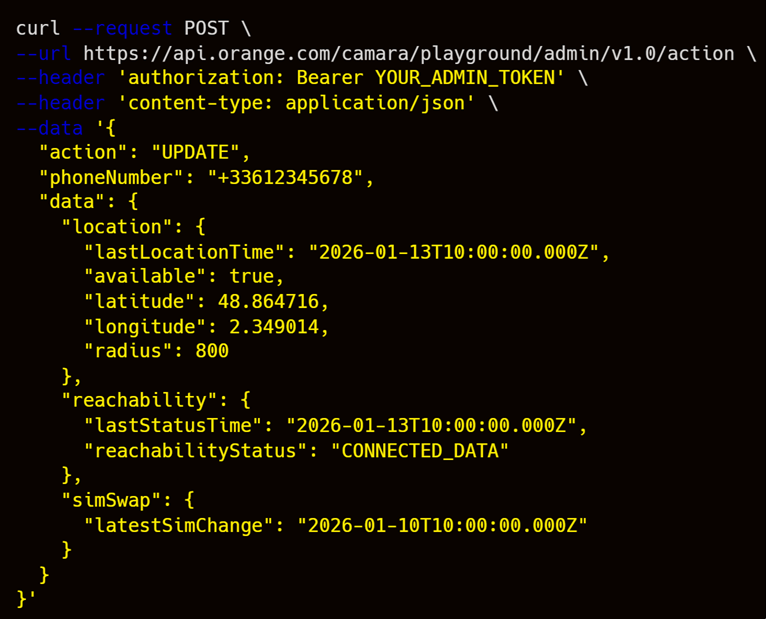
Test and explore our APIs with API Playground
Use the API Playground to take your first steps with Quality on Demand: understand the business logic (profiles, session lifecycle, app flow targeting) and learn the expected request format in a guided environment. It’s the fastest way for developers to validate how QoD fits their application journey before moving to deeper integration work.
The Playground is also useful to align product, engineering, and operations teams on when to trigger Quality on Demand sessions, and how to measure impact on your critical user journeys.
Get started today and bring your projects to life!
Frequently Asked Questions
Related APIs

Device Location Retrieval
Retrieve the geographical area position of a mobile device.


Device Location Verification
Verify if a mobile device is within a geographical area.