Voice API
Turn phone calls into secure, actionable voice data using Orange’s operator-grade programmable Voice API


Voice API: make voice programmable

A new chapter is opening for developers 🚀
Voice drives 70% of Customer Service Interactions — Yet, only 25% of these calls are leveraged to generate valuable analytics. When issues are complex, emotional, or high-risk, customers naturally turn to the channel they trust most: voice.
Voice API gives applications and services direct access to programmable calling capabilities through Orange’s telecommunications infrastructure. Developers can create and manage inbound or outbound calls, orchestrate voice scenarios, connect participants, retrieve media files and integrate voice data into their own platforms.
Instead of handling the phone call as an isolated interaction, Voice API turns it into a reusable digital asset that can feed AI models, CRM systems, AI agents and business applications.
Built on Orange’s network capabilities, Voice API provides a secure and scalable foundation for creating new voice-enabled products, automating communication workflows and enriching existing applications.
Watch the replay of our Voice API Masterclass
To support the launch of Voice API, Orange has hosted an exclusive event: the Voice API Masterclass, on September 29, 2026. On the agenda: product presentation, live demonstration, and a Q&A session with the team.
How it works
Voice API connects Orange’s voice infrastructure with your application through secure APIs and callbacks.
- Create or receive a call: initiate an outbound call through the API or associate an allocated phone number with an inbound voice scenario.
- Control the voice experience: use Orange Markup Language, or OML, to play audio, generate speech, collect keypad or voice input, connect participants and dynamically update the call scenario.
- Receive events and media: your application receives call-status notifications, action results, transcription updates and available media files through configured callbacks.
- Activate your applications: send the resulting audio, transcription or call metadata to your AI models, CRM, AI agents, analytics services or business applications.
Voice API manages call control, voice routing, media and orchestration. Your application retains control of the business logic, data processing and end-user experience.
Benefits

Operator-grade voice
Build on Orange’s telecommunications infrastructure to deliver reliable voice experiences designed for professional and business-critical applications.

Simple API integration
Use documented REST APIs, OML scenarios and event callbacks to add programmable voice capabilities to your existing products.

Inbound and outbound calls
Create outbound calls, configure inbound-call rules and connect calls to users, applications, bots or conferences.

Flexible call orchestration
Play prompts, collect user input, connect participants and update voice scenarios while a call is in progress.

Media and transcription
Retrieve available media files and enable live transcription when the required speech-recognition capabilities are activated.

Built for scale
Start with one use case and progressively extend your implementation across teams, applications, customers and business processes.

Secure by design
Use authenticated API access and controlled contracts while keeping your business logic and long-term data storage within your selected environment.

Ready for voice AI
Create a secure voice-data layer that can be connected to analytics, generative AI, conversational agents and automated workflows.
What does Voice API enable now and in the next 6 months*
Available now
• Programmable outbound calls
• Inbound-call rules for allocated numbers
• OML voice scenarios
• Audio prompts and speech input
• Call connection and conferencing
• Call and conference notifications
• Media-file management
• Live transcription with compatible services
Next step — industrialisation
• Simplified onboarding and developer experience
• Extended observability and operational tooling
• Improved documentation and integration examples
• Additional production-readiness validation
• Enhanced support for large-scale partner deployments
Future evolution
• Broader mobile-network integration
• Additional real-time voice and AI capabilities
• Expanded media-streaming options
• More advanced voice-agent orchestration
• Additional trust and fraud-prevention integrations
Roadmap information is indicative and may change according to technical validation, market priorities and country availability.
Build complete voice-enabled solutions
Voice API can be used as the core foundation of a standalone programmable-voice solution. On its own, it can:
- Create and manage outbound calls.
- Handle calls received on allocated numbers.
- Play audio files or generate speech.
- Collect keypad and speech input.
- Connect two callers or create conferences.
- Change a voice scenario during a live call.
- Receive call and conference status callbacks.
- Start and monitor live transcription.
- Store, retrieve and download supported media files.
- Connect external bots, applications and business workflows.
It can also be combined with complementary Orange APIs to create broader trusted-communication solutions:
Voice API + Branded call
Help applications combine programmable voice interactions with a clearer and more trusted calling identity, subject to service availability and compatibility.
Voice API + Number Verification
Associate voice workflows with verified mobile-number signals to strengthen onboarding, authentication or sensitive customer journeys.
Voice API + fraud-prevention signals
Combine voice interactions with signals such as SIM Swap or identity-verification APIs to adapt security controls to the risk level of the transaction.
Voice API + SMS API
Use SMS as a separate communication channel for confirmations, links, alerts or post-call follow-up. SMS capabilities are provided through a dedicated API and are not part of Voice API itself.
Use cases
Enrich your AI models
Provide authorised voice data to speech analytics, language models or specialised AI services to extract topics, intent, summaries and business signals.
Boost your CRM data
Turn calls into structured customer information such as conversation summaries, detected needs, follow-up actions and interaction history.
Enhance your AI Agents
Give AI agents access to telephony workflows so they can receive calls, gather information, route requests and trigger approved actions.
Upgrade your business applications
Add voice-driven workflows to customer-service platforms, recruitment tools, field-service software, booking systems and industry applications.
Build virtual receptionists
Welcome callers, identify the purpose of a call, collect information and route or process requests according to your business rules.
Automate call qualification
Use interactive voice scenarios to qualify leads, verify requests, capture structured input and route each caller to the right workflow.
Create voice-enabled support
Connect callers to automated assistance, human agents or specialist teams while preserving call events and context.
Develop post-call workflows
Retrieve the relevant media or transcription, process it in your application and automatically create tasks, notes, alerts or follow-up messages.
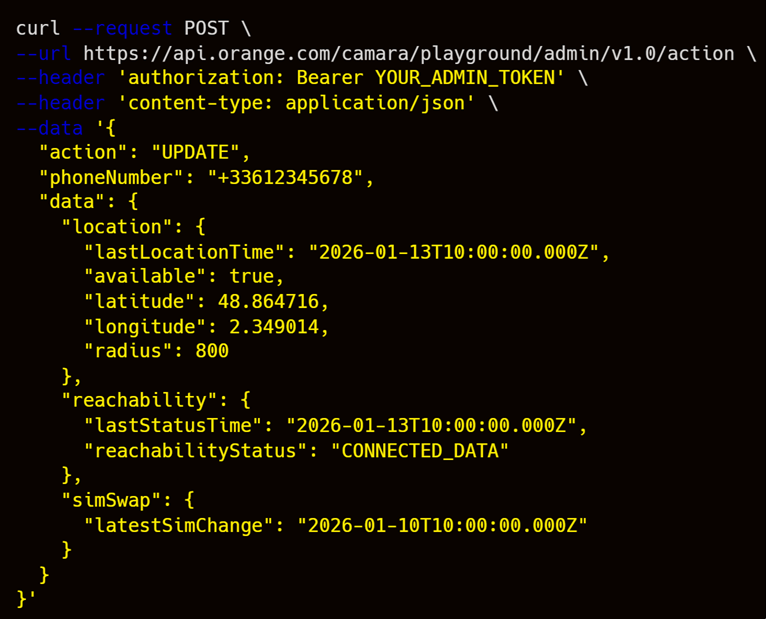
Test and explore our APIs with API Playground
Discover the API Playground: your interactive environment for testing and exploring Network APIs with ease! Prototype, validate, and experiment in real-time without impacting your live systems.
Get started today and bring your projects to life!
Case study
Hirify – when Voice API helps enforce sovereignty
Hirify targets high-volume interview organizations like recruitment agencies and IT service firms. It offers transcription, reporting, database reliability, and talent sourcing. Built on a sovereign French infrastructure using Mistral models, Scaleway, and Scalingo, it ensures data privacy. An internal AI assistant streamlines data entry, storing only essential ATS information.
One weak link remained: voice.
The Voice API, provided by Orange, completes the process by securely handling calls within France, ensuring data remains local and compliant with data protection standards.
Used APIs
 Voice API
Partners

Frequently Asked Questions
Related APIs

SIM swap
Perform real-time checks on the activation date of a SIM card on the mobile network.

Number verification
Check if the provided mobile phone number is the one actually used in the device.

Branded calling
Replace suspicious, anonymous strings of digits with an operator-certified business identity.
Subscribe to our Newsletter
Find out about the latest Orange Developer API product launches, events and news.