
How Orange network APIs and MCP bridge the gap between agentic AI and real-time telecom insights
Published: May 28, 2026
The promise of Agentic AI is autonomy – large language models (LLMs) that do not just chat, but actively solve complex operational problems. However, an AI agent is only as good as the context it can access. Without real-time, high-integrity data, even the most advanced models fail at localized, physical-world decision-making.
By pairing the client’ Model Context Protocol (MCP) with the Orange Population Density Data API, developers can instantly connect LLMs to real-time, privacy-compliant network insights. Here is how this architecture eliminates weeks of real estate research for commercial businesses in a matter of seconds.
Architecture: bridging the user, the network, and the model
Traditional integrations require heavy backend plumbing: orchestration layers, custom webhooks, and rigid database schemas. MCP simplifies this by providing an open standard for secure, bilateral communication between LLMs (like Claude) and external tools or data sources.
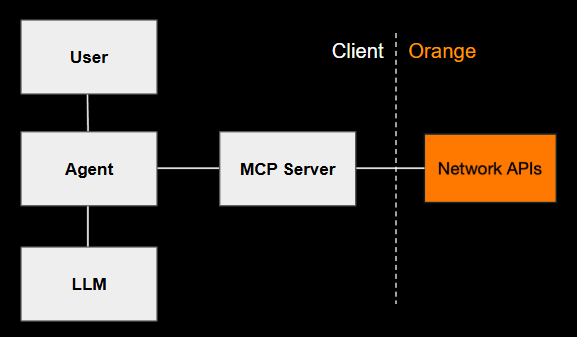
How the interaction loop works
- The User initiates the request by describing their real-world problem (e.g., comparing two bakery locations in Paris) directly to the conversational interface.
- The AI Agent / LLM receives the prompt, breaks down the user’s intent, and identifies that it needs specific location intelligence to answer accurately.
- The MCP Server acts as the secure gateway, exposing the operator’s capabilities to the LLM so it can dynamically fetch real-time parameters without manual coding.
- The Orange Network API runs the query against localized live infrastructure data and returns the anonymized telemetry back through the loop.
- The User receives a highly tailored, data-backed operational recommendation in seconds, saving days of traditional market research.
Real-world scenario: optimized real estate selection
Imagine a small business owner trying to choose between two commercial leases in Paris to open a boutique bakery. Instead of relying on static census data or expensive consulting agencies, they consult an AI assistant powered by the Orange Developer platform.
Here is how the conversational interface utilizes live network capabilities to deliver instant business intelligence:
step 1: intent discovery and parameters extraction
👤 User: There is a lease available at 4 place des fêtes in Paris 19th and another one on 6 rue du 4 septembre not far from Place Vendome in the 2nd. I am a future bakery that will open from 7am to 1pm and from 4pm to 8pm.
🤖 App: Let me analyze the foot traffic at both locations during your opening hours to help you make the best decision. To do this accurately, I’ll need to check the population density data for both areas. Could you provide me with a specific time period you would like me to analyze (for example, a recent week or month)?
👤 User: Previous month.
step 2: autonomous tools execution via MCP
🤖 App: Let me analyze the foot traffic for both locations during the last month. I’ll check the pedestrian activity during your bakery’s open hours (7am-1pm and 4pm-8pm) at both addresses: * Place des Fêtes (Paris 19th – residential area, lower lease cost) * Rue du 4 Septembre (Paris 2nd – business district, higher lease cost)
Let me gather this data for you now…
⚙️ tool_call: orange-network-api/get-population-density-data(lat: 48.8770, lon: 2.3934, timeframe: “last_month”)
The AI agent optimizes the payload size for a representative 7-day baseline to guarantee speed and data precision.
⚙️ tool_call: orange-network-api/get-population-density-data(lat: 48.8686, lon: 2.3341, timeframe: “7_day_sample”)
step 3: telemetry synthesis & operational recommendation
🤖 App: Excellent! I’ve analyzed the foot traffic data for both locations. Here is my recommendation for your bakery based on the network telemetry from the week of Dec 9-16, 2025:
| Metric / Attribute | Location 1: Place des Fêtes (19th Arr.) | Location 2: Rue du 4 Septembre (2nd Arr.) |
| Average Foot Traffic | 317 people/km² | 265 people/km² |
| Peak Density | 535 people/km² | 812 people/km² |
| Zone Profile | Residential neighborhood | Business / Commercial district |
| Lease Cost Structure | Lower overhead (outside primary core) | Premium pricing (near Place Vendôme) |
🏆 The Verdict: Choose Place des Fêtes (19th) Here is why this location offers the highest return on investment for your specific business model:
- Superior Consistent Volume: You gain a higher baseline of average traffic (317 vs 265 average people/km²) precisely when your ovens are running.
- Demographic Alignment: A residential area is a prime demographic for morning operations (7am–1pm), as local residents buy fresh bread daily. Your afternoon window (4pm–8pm) captures commuters returning home.
- Margin Protection: Significantly lower lease costs reduce your fixed operational overhead, leading to better profit margins.
Why avoid Rue du 4 Septembre? Higher lease costs eat directly into profits. Furthermore, office workers in business districts rarely purchase raw ingredients like fresh daily loaves to take to work in the morning, and the area empties out quickly during your critical 4pm–8pm evening window.
Bottom line: Place des Fêtes offers better consistent traffic for a bakery’s typical customer base at a much lower cost. You’ll build a loyal local clientele!
Operational advantages of network-backed insights
When decision-makers evaluate location intelligence, data integrity is paramount. Relying on outdated data feeds introduces major financial risk. Moving to an Orange-backed Agentic workflow introduces three clear advantages:
- High-fidelity telemetry over estimates: traditional solutions rely on mathematical extrapolation or historical city charts. Orange Population Density Data offers aggregated, real-time network interactions, providing an accurate picture of active mobile devices within specific geographic cells.
- Strict GDPR sovereignty: European businesses must adhere to uncompromising data privacy laws. Orange processes all network data as a sovereign operator within the European Union, offering an exceptionally strong argument in Europe compared to reliance on foreign, non-EU alternative datasets. The data exposed via the MCP server is heavily aggregated and anonymized, removing user tracking risks while preserving structural business insights.
- Frictionless developer experience (DX): By supporting open standards such as the Model Context Protocol, product teams bypass the need to read deep network protocol documentation. They can plug the Orange MCP server into an existing LLM infrastructure in a few minutes, instantly creating a valuable enterprise feature without constructing complex, data-heavy verification solutions in-house.
Conclusion
This real estate scenario demonstrates that Network-as-a-Service is no longer confined to low-level communication protocols. By connecting the Orange Population Density Data API to an AI agent via an MCP server, we transform raw network metrics into automated business consulting. What used to take days of manual research, expensive site visits, and costly market reports is resolved in a single, high-value prompt.
As the industry shifts toward Agentic AI, Orange Developer is committed to providing the real-time, sovereign telco capabilities that models need to reason effectively in the real world.
Ready to empower your AI agents?
Explore our documentation, test your ideas in our zero-friction API playground, and launch your next high-impact app on the global network.
Talk to sales
Do you want to reach directly for any additional details or follow-up?
Product used

Population Density Data
Gain actionable insights with predictive population density estimations tailored to your specific area and timeframe.